Steps of creation
List elements from catalog:
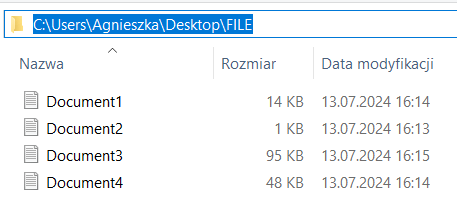
import os
import time
def get_files_details(directory):
    details = []
    for filename in os.listdir(directory):
        if filename.endswith(".txt"):
           filepath = os.path.join(directory, filename)
           file_size = os.path.getsize(filepath)
           file_modification = time.strftime('%H:%M:%S',
                               time.gmtime(
                                   os.path.getatime(filepath)
                               ))
           details.append([filename, file_size, file_modification])
    return details

directory = r"C:\Users\Agnieszka\Desktop\FILE"
details = get_files_details(directory)
If we want to list songs or videos we have to install mutagen lib:
from mutagen.mp4 import MP4 #pip install mutagen
for images we will use Pillow lib:
from PIL import Image #pip install Pillow
#Enter the music catalog to get songs names
import os
from mutagen.mp4 import MP4  #pip install mutagen
import time

#SELECTING FILES FROM ONE CATALOG:
def get_music_files_details(directory):
    details = []
    for filename in os.listdir(directory):
        if filename.endswith(".mp4"):
           filepath = os.path.join(directory, filename)
           file_size = os.path.getsize(filepath)
           audio = MP4(filepath)
           duration = time.strftime('%H:%M:%S',
                                    time.gmtime(audio.info.length))
           details.append([filename, file_size, duration])
    return details

directory = r"C:\Desktop\MUSIC\BAND_NAME\ALBUM"
details = get_music_files_details(directory)

print(details)
#Enter the music catalog and read: band names, album names and songs names
import os
import pandas as pd
from mutagen.mp4 import MP4  #pip install mutagen
import time

def get_music_files_details(directory):
    details = []

    #LIST OF FOLDERS (BAND NAMES) IN THE SPECIFIED PATH (X:\MUSIC)
    for catalog_name in os.listdir(directory):
        catalog_path = os.path.join(directory, catalog_name)
        #details.append(catalog_name)

    #LIST OF ALBUMS FROM EACH SUBFOLDER W (X:\MUSIC):
        if os.path.isdir(catalog_path):
            for subcatalog_name in os.listdir(catalog_path):
                subcatalog_path = os.path.join(catalog_path,
                                               subcatalog_name)
                #details.append([catalog_name,subcatalog_name])
    #SONGS LIST
                if os.path.isdir(subcatalog_path):
                    for filename in os.listdir(subcatalog_path):
                        if filename.endswith(".mp4"):
                           filepath = os.path.join(subcatalog_path,
                                                   filename)
                           #MB size calculation
                           file_size = round(
                               (os.path.getsize(filepath)/1048576),2)
                           audio = MP4(filepath)
                           #song duration
                           duration = time.strftime('%H:%M:%S',
                                                    time.gmtime(audio.info.length))
                           #get song name from filename '1 Band Name - Song Name.mp4':
                           song_name = (
                               filename.split(' - ')[-1].rsplit('.', 1))[0]
                           #lista koncowa:
                           details.append([catalog_name, subcatalog_name,song_name,
                                           file_size,duration])
    return details

directory = r"X:\MUSIC"
print(get_music_files_details(directory))
Export as TXT and an Excel file
def main():
    directory = r"X:\MUSIC"
    details = get_music_files_details(directory)

    # DataFrame
    df = pd.DataFrame(details,
                      columns=["Band", "Album", "Song",
                               "File Size (MB)", "Duration"])

    # Excel
    excel_file = "music_files_details.xlsx"
    df.to_excel(excel_file, index=False)
    print(f"The details of the music files "
          f"have been saved in "
          f"{excel_file}")

    # TXT
    text_file = "music_files_details.txt"
    df.to_csv(text_file, index=False, sep='\t')
    print(f"The details of the music files "
          f"have been saved in"
          f" {text_file}")


if __name__ == "__main__":
    main()
 Heart4DataScience