
When we meet an error or an exception while our code is running, Python will normally stop and generate an error message in red.
We can handle it using try, if statement, except & raise our own error methodology.
Example #1
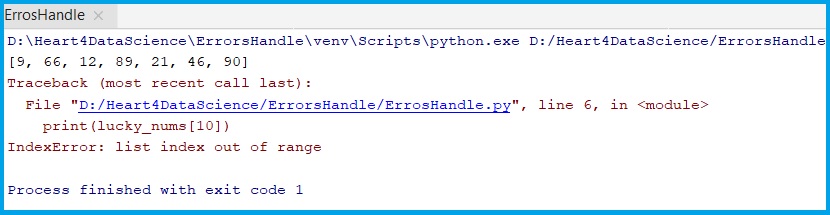
lucky_nums = [9,66,12,89,21,46,90]
print(lucky_nums[10])
We will get an error message, that mifght be not clear for us or final user:
lucky_nums = [9,66,12,89,21,46,90]
print(lucky_nums)
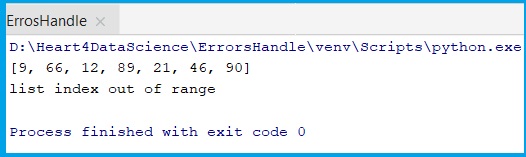
min = 0
try:
    lucky_nums[10]
except IndexError:
    print('list index out of range')
lucky_nums = [9,66,12,89,21,46,90]
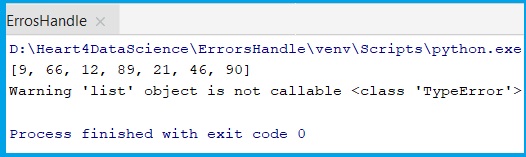
print(lucky_nums)
min = 0
try:
    lucky_nums(10)
except IndexError:
    print('list index out of range')
except Exception as Ex:
    print('Warning',Ex,type(Ex))
else:
    print("good shot! this is your lucky number!")
Example #2
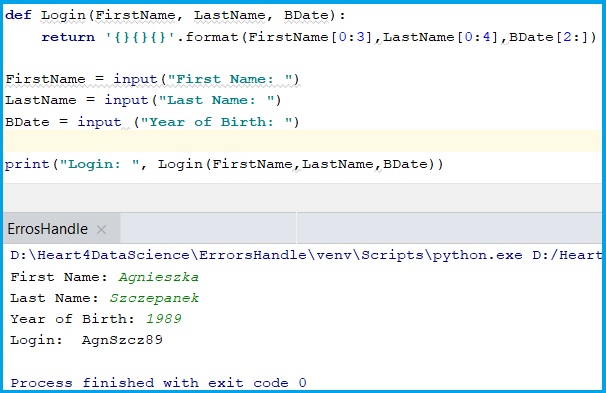
Let’s create a simple functions at first.
def Login(FirstName, LastName, BDate):
    return '{}{}{}'.format(FirstName[0:3],LastName[0:4],BDate[2:])

FirstName = input("First Name: ")
LastName = input("Last Name: ")
BDate = input ("Year of Birth: ")

print("Login: ", Login(FirstName,LastName,BDate))
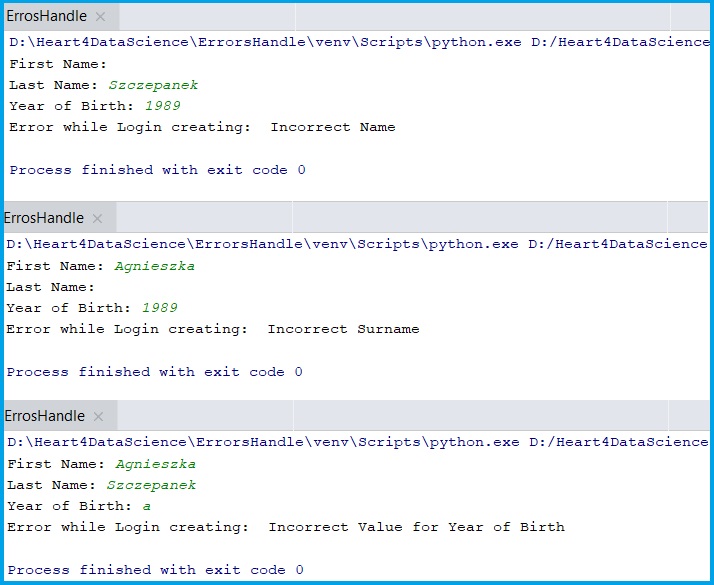
Inside we need to declare possible error that we might get while someone put wrong Name, Surname or Year:
class WrongInputs(Exception):
    pass
def Login(FirstName, LastName, BDate):
    try:
        Login_FirstName = FirstName[0]
    except:
        raise WrongInputs("Incorrect Name")
    if len(LastName) <1:
        raise WrongInputs("Incorrect Surname")
    Login_FirstName = LastName[0]
    if not BDate.isnumeric():
        raise WrongInputs("Incorrect Value for Year of Birth")
    Login_Bdate = BDate[0]

    return '{}{}{}'.format(FirstName[0:3], LastName[0:4], BDate[2:])

FirstName = input("First Name: ")
LastName = input("Last Name: ")
BDate = input ("Year of Birth: ")
try:
    print("Login: ", Login(FirstName, LastName, BDate))
except WrongInputs as Ex:
    print("Error while Login creating: ",Ex)
except IndexError:
    print('list index out of range')
 Heart4DataScience