NumPy

NumPy – programming language library, written partially in Python, but most of the parts that require fast computation are written in C or C++. Adding support for large, multi-dimensional arrays and matrices, along with a large collection of high-level mathematical functions to operate on these arrays. Arrays are stored at one continuous place in memory unlike lists, so processes can access and manipulate them very efficiently. NumPy is open-source software and has many contributors.

Lib Install

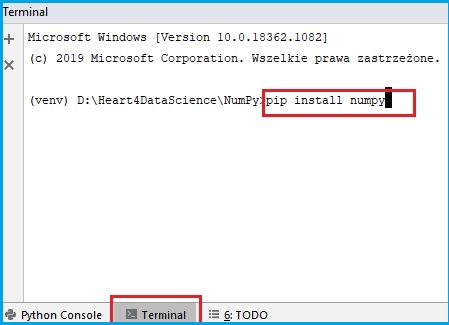
to install numpy we need to go to terminal in our project (on the bottom list we should have : Python Console, Terminal, TODO, clik on Teminal option) and write a simple line of code: pip install numpy
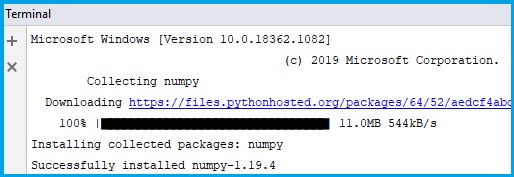
we might get some error due the installation process. If so, we need to check, if our python and pycharm env included terminal package PyCharm Community Edition 2018.2.4\plugins\terminal\ and libraries Python36_32bit\Lib. Lib Succesfully installed :

After installation is complited, we can turn back to the project, open file and start use library by adding this simple command above:

import numpy

Intro Example #1

We can also give a short name to the lib, so we can easily use it elements:

import numpy as np
vec = np.array([1, 2, 3, 4, 5])
print(vec)

Checking version

print(np.__version__)

Intro Example #2

dimens = np.array([[1, 2, 3], [4, 5, 6]])
print(dimens)
Recursion, Iterators & Generators

Recursion is defined in terms of itself or of its type and is used in a variety of disciplines. Mostly used in mathematics and computer science, where a function being defined is applied within its own definition.

#Recursion Example1

Nums = [2,4,6,8,10]

def Nums_sum(Nums):
    if len(Nums) == 0:
        return 0
    First_Value = Nums[0]
    Rest_Values = Nums[1:]
    return First_Value + Nums_sum(Rest_Values)

print("Recursion Example1 result: ", Nums_sum(Nums))
#Recursion Example2

def fun(n):
    if n == 0:
        return 0
    if n == 1:
        return 1
    return fun(n - 1) + fun(n - 2)

res = fun(25)
print("Recursion Example2 result: ",res)
#Recursion Example3
snake = {1:2, 2:6, 3:9, 4:12, 5:15, 6:18, 7:21, 8:24, 9:27, 10:30}

elems = list(snake.values())
elems.reverse()
print("Recursion Example3 result: ", elems)

print("Recursion Example3 loop result: ")
for x in range(len(elems)-3):
    print(elems[x]*elems[x+1])
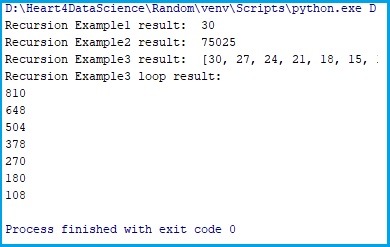
results

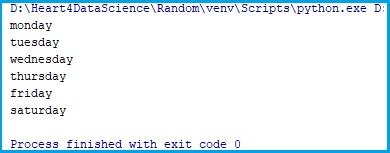
Iterator – an object that allows sequential access to all elements or parts contained in another object, usually a container or list.

#Iter Example1

days = ("monday", "tuesday","wednesday" ,"thursday", "friday", "saturday", "sunday")
it_days = iter(days)
print(next(it_days))
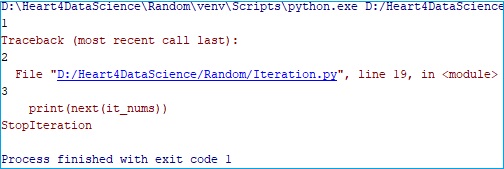
#Iter Example2
nums = (1,2,3)
it_nums = iter(nums)

print(next(it_nums))
#Iter Example2 modified
class Nums:
    def __iter__(self):
        self.x = 1
        return self
    def __next__(self):
        if self.x < 4:
            y = self.x
            self.x +=1
            return y
        else:
            raise StopIteration

Nums_vals = Nums()
NumsIt = iter(Nums_vals)

for i in NumsIt:
    print(i)

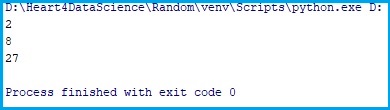
Generators familiar with iterators, allow to create functions returning successive values ​​from a certain sequence. With directive yield let the generator to pause until it is retrieved values ​​by the next function.

#Gen Example1
def Nums(val):
    x = 1
    score = 2
    while x <= val:
        yield score
        x +=1
        score = x**3

for i in Nums(3):
    print(i)
result
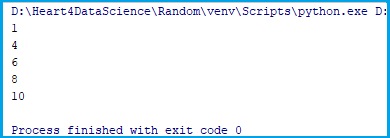
#Gen Example2
def Nums(val):
    x = 1
    score = 1
    while x <= val:
        yield score
        x +=1
        score = x*2

for i in Nums(5):
    print(i)
result

How about this:

for n in [i for i in range ( 10 ) if i % 2 == 0 ]:
    print (n)